The blessed and the sycophant: To argue theology, consult a theologian, not a politician
“Blessed are the Peacemakers: for they shall be called children of God”
Sermon on the Mount, Matthew 5:9
The questions of the morality of war and love for one another are best found in the words of Jesus Christ, according to Pope Leo XIV. Who better to explain the value of those beliefs to the world than a man with this impressive educational resume in the area of theology:
Minor Seminary of the Augustinian Fathers
Villanova University, B.A. mathematics and philosophy — 1977
Catholic Theological Union, Master’s in Divinity — 1982
Pontifical University of St. Thomas Aquinas, Rome
Licentiate in Sacred Theology (STL) — 1984
Doctorate in Canon Law (STD) — 1987
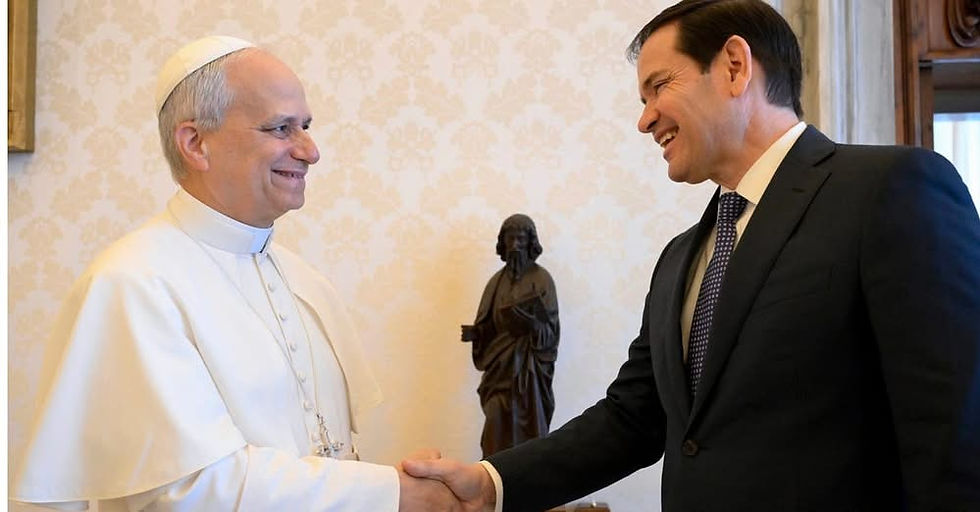
Therefore, when the Pope explains that war is morally wrong, that nuclear weapons are morally wrong, and that hating people because they are a different race or religion from others is morally wrong, he is using the book of the bible that his visitor Marco Rubio and many other Americans ignore: The New Testament.
They ignore the words of Jesus Christ when he explains that there are only two great commandments:
37 And he said to him, “You shall love the Lord your God with all your heart, and with all your soul, and with all your mind. 38 This is the great and first commandment. 39 And a second is like it, You shall love your neighbor as yourself. 40 On these two commandments depend all the law and the prophets.”
Matthew 22:37-40, Revised Standard Version of the Bible: Catholic Edition, © 1965
In short, “Love God” first, and then “Love Your Neighbor as Yourself.” It is the second of these that Rubio and his evangelical friends and the people in the inhumane administration that hired him like to ignore.
These neighbors that Jesus said we should love include immigrants — migrants, just like Jesus, Mary, and Joseph were in the Bible.
We do not have to like everyone: Just love them.
Sounds counter-intuitive. Perhaps it is, but those are the words of God that Jesus focused on in his earthly mission.
Sending the wrong missionary
So, why in the world would the current government of the United States send such a flawed individual to argue theology with the most knowledgeable and moral man in the world?
Especially with the politician's background.
Catholic, Mormon, Catholic, Southern Baptist, Catholic — all over the place.
Rubio’s religion has varied extensively, but what is interesting is how his political quests have governed those changes. While born a Catholic, he was a Mormon, a Southern Baptist, and now a Catholic again.
When he was running for president himself, he found himself in a band of people who did not think he was being honest or realistic,
Rubio launched into a virtuoso, 10-minute-long, let-me-at-it telling of his circuitous faith—Catholicism to Mormonism back to Catholicism to a Southern Baptist Convention-affiliated evangelical megachurch and finally back to Catholicism—as well as passionate and particular evidence of the depth of his knowledge of the Bible
… “I’m fully, theologically, doctrinally aligned with the Roman Catholic Church,” Rubio had said—and for people like Joe Brown, the influential leader of the Marion Avenue Baptist Church in rural Washington in the southeastern part of the state, that no-wiggle-room declaration was a deal-breaker.
“Most pastors and evangelicals do not believe you can be a Catholic and be an evangelical at the same time.”
Michael Kruse, “Marco Rubio’s Crisis of Faith,” Politico, May 8, 2020
That last sentence focuses on the reality of Rubio’s dilemma: He has vacillated so much with religion that he cannot even begin to argue philosophy with a man with a doctorate in Sacred Theology.
What makes this even more incongruous is that so many of these changes occurred because of where he was in his political career. He became a Southern Baptist while a Florida state legislator who wanted to be a U.S. Senator from a state that is only about 15 percent Catholic at that time. Being called a Catholic in Florida would not help with voters— the word Baptist worked better.
When he then wanted to focus on a national agenda and run for president, he again embraced Catholicism and tried to play both sides by attending churches of both faiths.
Major distinction between Catholics and Evangelicals
The irony of the beliefs of Catholics and Evangelicals can be discerned in a quote from a well-known intellectual who is an avowed atheist,
For some reason, the most vocal Christians among us never mention the Beatitudes (Matthew 5). But, often with tears in their eyes, they demand that the Ten Commandments be posted in public buildings. And of course, that's Moses, not Jesus. I haven't heard one of them demand that the Sermon on the Mount, the Beatitudes, be posted anywhere. 'Blessed are the merciful' in a courtroom? 'Blessed are the peacemakers' in the Pentagon? Give me a break!
Kurt Vonnegut, Goodreads
Actually, that is what Pope Leo is arguing, that the beatitudes are vital to followers of Christ. The Ten Commandments tell people what not to do, but the beatitudes tell us how to live our lives in a moral way that pleases God.
However, evangelicals do not believe that living a moral life in which they help others will earn a spot in heaven as long as you embrace a right-wing religion and are born-again. Forget about the sins that the people commit in life, like sexual assault and pedophilia. They do not see the importance of that, though the affair in the Oval Office in the 1990s repulsed them [and me].
In addition, they do not believe in confession or penance.
Rubio is more like the evangies in this respect.
The conversation between the two men
One American attempted to discern what the conversation between the the pope and the sycophant may have looked like earlier this week,
One man took vows.
The other abandoned them.
On the other sits a man who knows those truths — who once spoke them — and who now participates in their betrayal.
There are no talking points that can reconcile those realities.
There’s no scripture that can be tweeted to bridge that gap …
[Pope Leo XIV] Robert Prevost isn’t a politician. He isn’t a man who must triangulate or hedge or contort himself to survive the next news cycle. He has taken vows that demand coherence between word and deed. Between belief and action.
He represents an institution that, for all its imperfections, still dares to speak in the language of moral absolutes — of human dignity, of care for the poor, of peace over war.
Across from him sits a man who quotes the same scriptures, while enabling policies that contradict them at every turn.
What does that conversation sound like?
Does Rubio quote [the book of] Matthew?
Does he speak of charity, while defending the starvation of children?
Does he invoke peace, while rationalizing the next war?
Or does he, even for a moment, confront the dissonance?
Because there is dissonance at the heart of this moment …
There’s only the question that hovers over the room, unspoken, but undeniable: what does it profit a man to gain the world and lose his soul?
Steve Schmidt, “The priest and the sycophant,” Substack
Defending the indefensible
What made the journey to the Vatican even more problematic is the man whom Rubio is representing. Can you think of any person in American public office who has been more reprehensible? Accused of dozens on instances of rape, accused of being very close with the worst child sexual trafficker in history, a person who practices no religion yet makes political hay out of it, and who is the worst role model in history?
Yet, Rubio has sold his soul, or what is left of it.
Pope Leo was cordial in the visit, but this much is clear: In his one-on-one conversation away from others, he no doubt explained the Catholic Church’s doctrine of a Just War and of war itself, discussed how Jesus Christ was a brown-skinned migrant who talked about loving one another, and of how the United States was not following a moral course that Jesus would approve of were he here today.
He, in a nice way, explained how away from Catholic theology Rubio is.
Cordial? Yes.
Frank? Even more so.
And he no doubt indicated that he did not approve of Iran having nuclear weapons -- because opposed the use them by any country.
He did not call out the lies because he does not have to do so. The Vatican does its homework -- he realizes what his approval rating is, and he knows that it is for the other side.
Unfortunately, the message will be lost on this fallen-away Catholic who may eventually turn to a Southern Baptist again if he runs for president in 2028.


Comments