“The Fighting Irish” battled the Ku Klux Klan in South Bend, Ind. and in Lilly, Pa in 1924
Updated: Feb 11
“Notre Dame and the Klan”
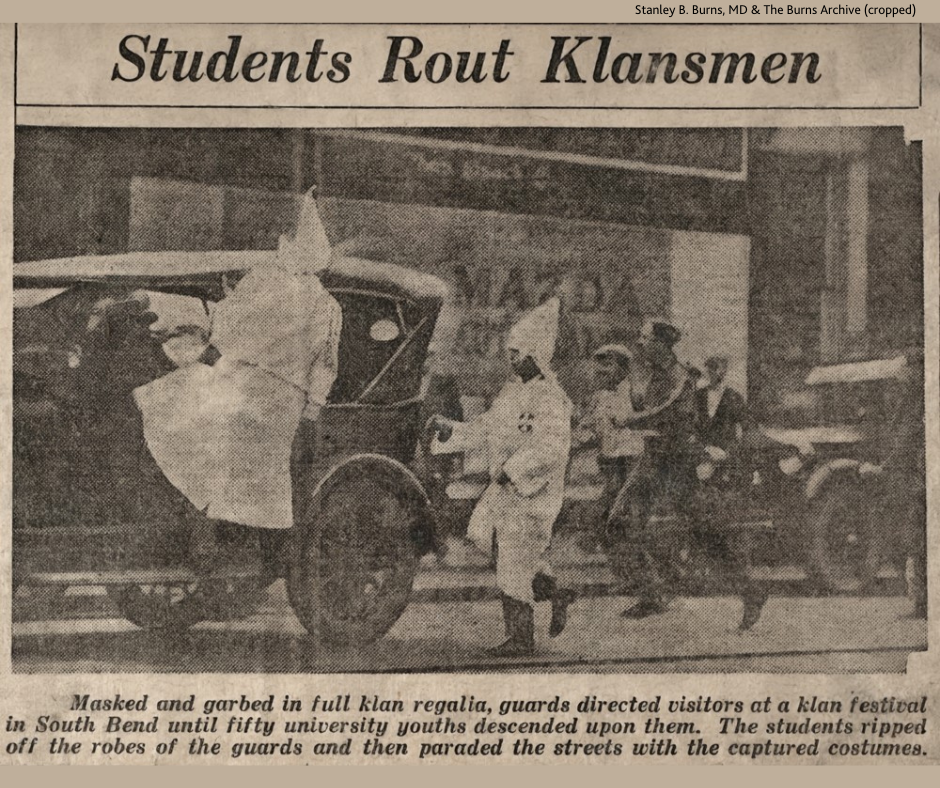
Many contemporary college football fans do not understand that the moniker that has made Notre Dame famous was not one that the team earned on the field. Instead, the original "Fighting Irish" battled the Ku Klux Klan more than a century ago that featured Protestants against Catholics and earned that appellation.
In South Bend, no one died, and the battle was more physical than the use of weapons — guns — than the one that killed three in Lilly, including my uncle, Phil Conrad. What is also ironic about this is that the two confrontations took place a little more than a month apart in 1924.
And what is even more ironic is that some in Notre Dame today think that the animus of that battle is still alive in America.
The final irony is that the KKK came to Lilly for the same reason that they invaded South Bend: To battle the Irish-Catholics whom they believed were anti-American and had denigrated America.
The South Bend Fighting Irish
I am writing this while on an eight-hour trip from the US midwest to Honolulu, Hawaii. I started reading the book “Notre Dame vs. the Klan” by Todd Tucker more than five years ago. It was fascinating because though I havefollowed college football, I never knew that the “Fighting Irish” moniker resulted from the same KKK battle that killed my uncle Phil Conrad in 1924.
On the anniversary of that battle last year, an exhibit called “RESIST!” was compiled at the Indiana History Center. The Lilly battled lasted just three and a half hours on one night, but the Notre Dame confrontation covered three days.
Tucker’s book outlines much of the history of how Notre Dame became a major university but also how this event was a significant confrontation because it epitomized the battle between Catholics and Protestants in the 1920s.
A story about that historical exhibit last year introduced to many in the country and the state of Indiana just how strong the KKK was in that area in 1924 — and that indeed, it was not primarily a racist organization but focused on Catholics,
When you hear the phrase “The Fighting Irish,” you no doubt think about the University of Notre Dame and its storied football program. What you may not know is how hundreds of Notre Dame students lived up to that once-derogatory moniker in a decisive and history-making way.
One hundred years ago this week, The Fighting Irish (then known as the Ramblers) scored perhaps their biggest victory ever. It didn’t take place on the football field but on the streets of downtown South Bend, where students waged a three-day brawl with the Ku Klux Klan.
Tim Sexton, associate vice president of public affairs at Notre Dame, calls it “a pivotal moment in Indiana and Notre Dame history, with Notre Dame students joined by community members to defend religious freedom and reject hate.”
Those three days are the focus of RESIST!, a new exhibit at the Eugene and Marilyn Glick Indiana History Center. It recounts the events of May 17–19, 1924, through photos, documents, artifacts, and an immersive video.
The Klan, which had a headquarters in South Bend, planned a parade and rally to reassert its presence and stronghold in Northern Indiana. When Notre Dame students got wind of those plans, many made plans of their own and hoofed it downtown. That’s despite being urged by then university president Rev. Matthew Walsh to seek a peaceful solution and let things play out through lawful means.
Mary Milz, “How Notre Dame Students Battled The Klan 100
Years Ago,” The Indianapolis Monthly, May 16, 2024
Contemporary students at Notre Dame are very different from those at that time. Today, according to figures from AI, students have to be wealthy to attend the largest Catholic university in the country,
For the 2025-2026 academic year at the University of Notre Dame, undergraduate tuition and fees are about $67,607, with total estimated costs (including room, board, books, etc.) around $89,245.
AI, December 2025
The Irish who battled the Klan were much like those in Lilly, Pa.,
Mike Murphy, a 1979 graduate of Notre Dame and trustee of the Indiana Historical Society, says what the students did was heroic. “Those Notre Dame students who converged downtown were not the Notre Dame students of today. By and large, they were ethnic, blue-collar kids, often the first in their family to go to college,” Murphy says. “They fought not for what was in it for them but what they believed in.”
Milz, The Indianapolis Monthly, May 16, 2024

The Three Arches of Notre Dame
The Lilly Fighting Irish in the 1920s
Those in Lilly, Pa were very similar to those in South Bend at that time. The population of Lilly was 2,346 in the 1920 census, and the located of that community required people to be those same kind of blue-collar people at Notre Dame.
The community had grown by 43 percent from 1910 to 1920, so it was a bustling little community. The mainline of the Pennsylvania Railroad bisected the community, just as it still does today under another moniker. The men in the community worked in three areas: the railroad, the coal mines, and the steel mills. It was known as a coal-mining town, with Piper’s and Hughes’ mines the largest of those.
And in terms of ethnicity, the numbers are not clear except that the community was about 90 percent Catholic. St. Brigid’s was the Catholic Church and home of the Irish, but it also had Germans and Italians in it. The smaller Catholic Church was Our Lady of Mount Carmel, which was primarily a Polish church with numerous Slovaks in it.
However, those who battled the KKK that night were led by the Irish, though they were aided by quite a few Italians and some Polish.
I wrote this introduction to a story in Johnstown Magazine at the time of the 90th anniversary of the riot,
Nestled in a valley in the Allegheny Mountains of
west-central Pennsylvania, the community of Lilly
was similar to many other small coal towns along the
Pennsylvania Railroad. Many immigrants journeyed
there from Europe seeking a new life, carrying with
them the enticing quest to experience the American
Dream. Whether they worked in the coal mines, in
the steel mills, or on the railroad, residents of that
area were generally very religious, hard-working,
and family-oriented.
However, on the night of April 5, 1924, Lilly
collectively lost its innocence, a victim of intolerance
waged primarily by those who called themselves
“100 percent Americans.” They were white-robed
warriors who were bent upon confrontation. The
action ultimately caused heartache and misery for
many people, especially for the three mothers who
were forced to bury their sons because of the hatred
that spewed forth onto the streets that Saturday
night.
At least twenty more people were injured, and many
other families watched those close to them spend time
in prison for crimes that many believed they did not commit.
Hugh Conrad, “April 5, 1924: The night that Lilly lost its
innocence,” Johnstown Magazine, 2014
The question is why the KKK targeted a small town of just over 2,000 people to demonstrate that night. I interviewed one of the “fighting Irish” in Lilly who truly was an Irishman, a man who spent a year in prison as a result of the events of that night. In 2024, I spoke about him in a talk entitled “A Culture of Silence.”
A fighting Irishman
Jerry Carney grew up on a farm outside of Lilly, and he and his brother and other Irish became outraged when they found the Klan putting up an burning crosses in the community and county,
He was one of those who had spent a year in prison for the events of that night, and while I knew of the family who lived outside of Lilly, I had never met him.
He said that he would be happy to talk with me about it, and I did so in Altoona in 1992 when he was 87 years old.
In short, he was fiery and passionate. He called the events of that night a miscarriage of justice, and he was so angry about it that the purchased the transcript of the trial from the Cambria County courts.
Hugh Conrad, “A Culture of Silence,” 2024
And why did they come to Lilly? “Because we were Catholics and would tear down every cross they put up. They put two up in South Fork on St. Patrick’s Day, and we tore them both down before they burned them.”
The KKK ‘philosophy’
An analysis of the events at Notre Dame explained why the Klan hated the Catholics in the 1920s, quoting an historian named Kelly J. Baker,
The anti-Catholicism of the Klan movement was rooted in the fear that the Catholic Church’s hierarchy acted as a political party.Many Protestants saw the Pope’s authority over the faithful as the central problem within the Church, perceiving the power of the papacy to be parallel to a monarchy.
Klan publications highlighted the threat they believed the Catholic Church posed to America, namely the purging of, “All heretics, [and] Protestants…extirpate[ing] them from the face of the whole earth.” Aided by propaganda, these fears emboldened an already popular belief within many Protestant communities that if the Catholic population should exceed the Protestant, “religious freedom as we know it would end.”
Jacob Rooney, “Protestant resistance and Catholic Resilience: The Notre Dame Riot of 1924,” Tenor of Our Times, Harding University, 2025
Conclusion
So, the fighting Irish of Notre Dame had a significant tie to the fighting Irish of Lilly, Pa. In Lilly, three men were killed, two Catholics and one Protestant. While no one died at Notre Dame, the Catholic students believed that they had won a major battle — though the Protestants disagreed.
In Lilly, as I analyze this after studying the attack for more than 35 years, no one was victorious. It destroyed a community and exacerbated tensions that lasted for decades. Jerry Carney epitomized that bitterness when I interviewed him 70 years after that night. He never forgave the Klan for what they did to him — and to his fellow Irish Catholics..



Comments