Lilly’s famous battle with West Reading for the state basketball championship in 1959
- hughconrad52
- Mar 3
- 7 min read
Updated: May 13
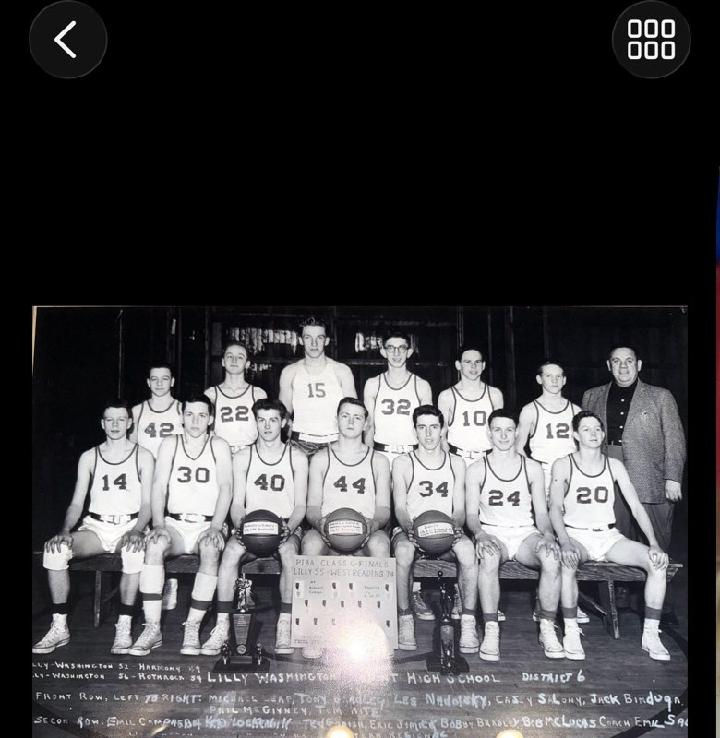
Caption: First row, Mickey Leap, Tony Bradley, Lee Nadolsky, Casey Salony, Jack Binduga, Phil McGivney, Tom Hite. Second row: Emil Campagna, Kenny Luckenbill, Thad Godish, Wes Appleyard, Bobby Bradley, Bobby McLucas, Coach Emil Salony.
Photos courtesy of Phil McGivney, son of Phil, who will be featured along with
his son in future stories.
Lilly-Washington High School’s chance to win a coveted state championship in 1959 was stymied by a 6-foot, 9-inch center.
The 1950s provided a much different style of high school competition for basketball teams in Pennsylvania from previous and even subsequent decades, and the Lilly-Washington Raiders took advantage of their unique opportunity in 1959.
At that time, Lilly held classes in a high school building that was without a gymnasium, so all of their games were played in the “Italian Hall.” This facility was near the War Memorial Field on Piper’s Street. The War Memorial was constructed in the late 1940s to honor the veterans while serving the living athletes with a quality football and baseball facility.
The Italian Hall building was somewhat cavernous, and I was never certain why it was built. The Italian Club had another building on Piper Street across the street that had provided social functions, including a bar and room large enough for dancing.
However, the Italians love their sports, and they spent some money to construct this — although I have never really seen a history of that facility.
The Hall, however, must have been built solely for the purpose of featuring high school events. It was a long enough court, but the drawback was that it had rafters that were probably only about 15 feet high — or so they seemed to me as a youngster. Hard to shoot a jumper or set shot from that spot in what is now three-point territory.
In addition, the seating was limited, with only two rows of bleachers along the court. The stage at the end of the court allowed a better view of the action.
The building had a stage that was used for events like the band concert, the class play, and the high school graduation. Regardless of its lack of pizazz, it was a beloved locus for the young people of Lilly.
For the 1959 team, the Italian Hall was the home of the Raiders of Coach Emil Salony.
Coach Salony
Emil Salony was a unique, generally-beloved man who became the school’s football coach in the 1930s. He was tough and gruff, but he commanded respect. He added the basketball duties out of necessity, but he was a football guy. He played college football for St. Francis College, and after graduation, became a teacher and a coach.
While he achieved success on the court, more was in football during the 1930s and late 40s than in basketball.
So, during the 1950s, he was guiding a team that faced many challenges. The first was that the high school had averaged just over 200 students from grades 9 through 12.
Schools were classified differently for basketball competition, with three different groupings: Class A for the largest schools, Class B for the medium-sized, and Class C for the smallest ones.
For the Raiders, this was challenging because they had to primarily play schools that were larger than they were. For instance, Cresson was twice as large as Lilly based on the number of high school graduates that they had. Cresson was a class B school, but a larger one. Gallitzin was also Class B, but they had few more students than Lilly. That was generally the case as they played larger schools until the playoffs.
The Gremlins were the team that everyone believed would reach the state title game in 1959. In fact, Gallitzin mauled the Raiders in a game on their home court, while having a battle on their hands in the Italian Hall before winning.
Unfortunately for the Gremlins, Gallitzin lost in the B regional playoffs and did not advance to the B-title game.
The Raiders' team
The regular season was about 18 games, and the Raiders had a losing record when they entered the District 6-C playoffs. Some question this, but the losing record idea was the one that I remember clearly because it was what many of the news stories focused on in their quest to reach the title game.
In addition, two people other than me talked constantly about the losing record since that was a great accomplishment. The first was Art Martynuska and the other was my father, Hugh B. Conrad, Sr.
Art was living in New York at the time of the 1958-59 team. However, when he came in to visit family over Christmas, he and some of the alumni were asked by Coach Salony to scrimmage his team. What Art remembered was this, ‘That team was not that good. We scrimmaged them and beat their [butts]. I could not believe that a team with a losing record could reach the state championship game.”
Art gave them tremendous credit for that accomplishment, but insisted that his teams in the 1940s were far superior to those. He was no doubt correct. He did, however, say that the teams that LWHS played on that road were rather suspect. They included Dale, Rothrock, Hyndman … none of which were strong programs. Nevertheless, the Raiders did pull out some nice wins.
My dad always credited those players for rising to the occasion in the playoffs, noting that they had a losing record — though it was a winning record at the end of the season.
So, my evidence for this is anecdotal, but such is history. However, the team played 18 regular season games, probably six or seven in December, eight in January, and maybe six more in January.
In the playoffs, the Raiders rose to the occasion. In the first game, they defeated Harmony by ten points, and edged Rothrock 56-54 to win their first District 6 championship. It was a tremendous win, and gave them the opportunity to enter the state playoffs — again for the first time.
They battled the District 5-C champ Hyndman in another close game, winning 43-39. In the western regional game, the Raiders again won a close game against Randolph, 52-49 to advance to the state championship game.
The regular season was about 18 games, starting in December with two games a week, every Tuesday and Friday, except for the Christmas holidays. Ironically, the Raiders had a losing record when they entered the District 6-C playoffs, and that was what fascinated the few media who used to cover the games. The losing record idea was the one that I remember clearly because it was what many of the news stories focused on in their quest to reach the title game.
However, in the playoffs, the Raiders rose to the occasion. In the first game, they defeated Harmony by ten points, and edged Rothrock 56-54 to win their first District 6 championship. It was a tremendous win, and gave them the opportunity to enter the state playoffs.
They battled the District 5-C champ Hyndman in another close game, winning 43-39. In the western regional game, the Raiders again won a narrow, hard-fought battle against Randolph, 52-49 to advance to the state championship game.
The powerhouse West Reading — Ron Krick

One of the major problems for Lilly that year was that the sites of the PIAA title games shifted from East to West and back each year. In 1959, the C title game was to be held in the East.
However, this game on March 20, 1959, was not just in the East. It turned out to be essentially a home game for the West Reading Cowboys. The championship game was held at the Albright College Field House, according to the website Berks Nostalgia.
Where is Albright College? In Reading, of course.
That was bad enough, but when Coach Salony saw a scouting report on the Cowboys, he knew that the Raiders would face a challenge like none other that they had faced that year.
A few years earlier, Salony’s aggregation had to battle another massive center, 6-8 Len Chappell from Portage. Every year, Chappell decimated the Raiders, and Salony knew that this challenge would be similar.
Though just a sophomore in 1959, Ron Krick was being recruited by every major college in the country, it seemed. In fact, Krick would go on to break a record set by the greatest player to come out of Pennsylvania — ever.
Krick eclipsed what was then thought to be an incredible mark,
Krick was a phenom, a headline grabber from the moment he stepped on the court for the Cowboys as a 6-5 freshman. In that era, though, sports achievements were more muted; they weren’t trumpeted in quite the same manner as when Donyell Marshall, Charlie Copp or Lonnie Walker IV were unveiling similarly incredible scoring feats.
Krick scored 39 points in 20 minutes that snowy February night in the old West Reading gym before a reported 600 people. When he put back a miss to top Wilt’s storied mark of 2,252 points, the fans gave him a standing ovation, the game was stopped and he was presented a ball to mark the occasion …
Krick would go on to become the first Pennsylvania prep player to reach 3,000 points; he finished with 3,174. Remarkably, only three others have passed him in the six decades since: Mansfield’s Tom McMillan (3,608) in 1970; Carlisle’s Billy Owens (3,299) in 1988; and North Bedford’s A.J. Nastasi (3,833), who graduated in 1998.
Reading Eagle, 2020

Photo Reading Eagle
The Raiders
Lilly-Washington did not have one standout performer in 1959. It was completely a team effort. However, the two players who were presented with the task of shutting down Krick were centers Casey Salony and Jack Binduga.
Casey was simply a tough, physical inside presence from a guy who went on to play college football at the University of Arizona. He really had no offensive skills, but he could battle with the best of them physically underneath the bucket.
He was, however, just about 6-feet tall, and in every game that year, he ran into foul trouble because of his physical play. That meant that a taller player, Jack Binduga, would come off the bench. Jack, however, was just about 6-1, and he also did not have the physical skills of Casey.
The result was simple: Krick scored 35 points against the Raiders in a 74-55 victory by the Cowboys.
The strength of the Raiders was in their guards. Mickey Leap was an outstanding scorer, and Lee Nadolsky and Tom Hite were outstanding ball handlers. Tony Bradley and Phil McGivney were the standout forwards on the team.
While they did not win the title, their accomplishment can be remembered now, 67 years later, when most of the starters have passed away. It was a great accomplishment for the Raiders just to reach the game, and despite the problem of facing one of the greatest players in Pennsylvania history, they battled hard to stay in the game.
It was also Coach Salony’s greatest accomplishment as a mentor to guide a team that struggled through the season against much larger schools to a Class C title game.
Note: Thanks to Phil McGivney, son of the 1959 player, for the photos from the 1959 team.


Comments