Rob Reiner: From the feisty Michael Stivic, aka “Meathead,” to a superb leader in the entertainment industry and a beloved firebrand
- hughconrad52
- Dec 18, 2025
- 4 min read

Loving him from start to finish
So many of us loved the show at the time: It hit the airwaves the year that I graduated from Penn State — 1971. As a student who had battled through the challenges of life in the 1960s and 70s, I could definitely relate to the philosophy of Michael Stivic in “All in the Family” which starred Carroll O’Connor as the now-iconic Archie Bunker.
However, I could also understand the beliefs of Archie after growing up in a blue-collar area. The difference was that I had never experienced the kind of blatant bias that Archie presented in such a funny, but incisive way on the Norman Lear show.
During those college years, I watched little television, but some like Mary Tyler Moore and Bob Newhart were great. All in the Family, though, presented something else entirely.
The focus of the show was a generational break between the World War II generation and the Baby Boomers. That battle I understood very well, and issues like the Vietnam War, Civil Rights, individual liberties, and other intense areas were at the forefront of the show.
The show was intense and confrontational, but very interesting and socially relevant.
The Family
As I recalled the show, I remembered this overview,
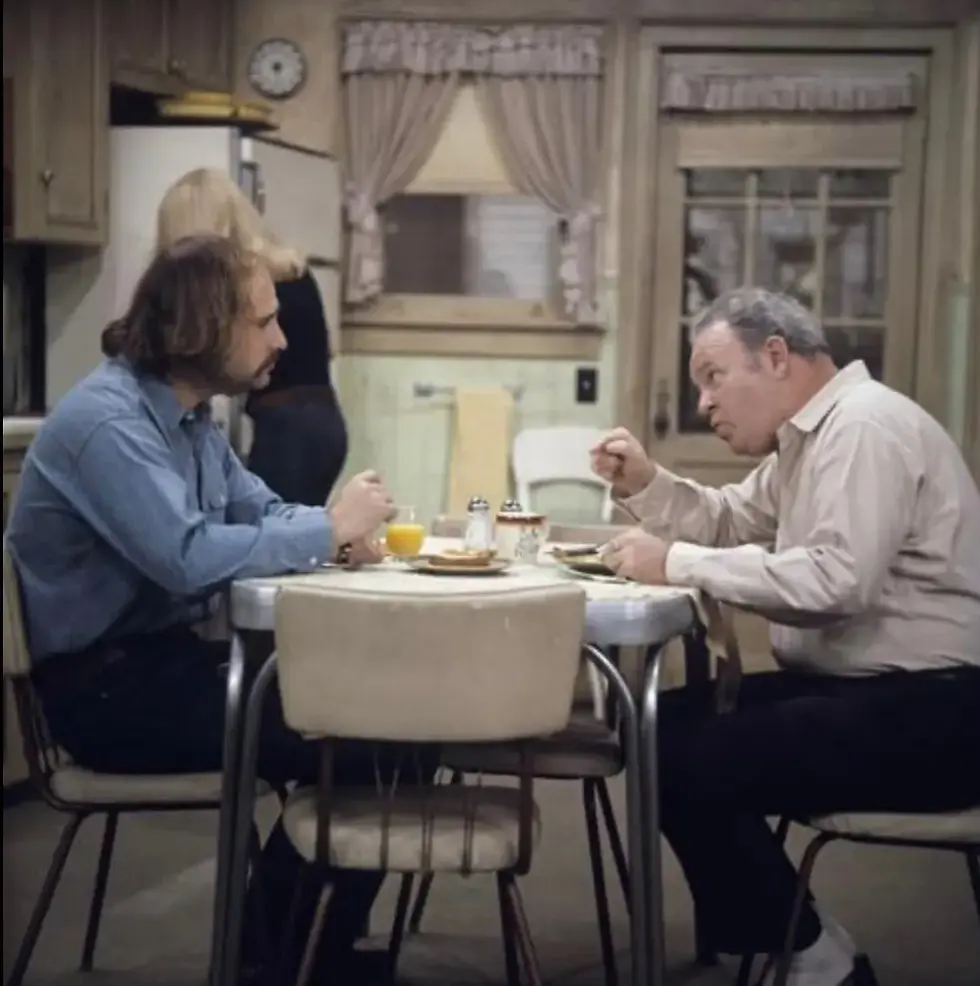
“All in the Family,” which stormed onto American TV sets in 1971, was a showcase for Carroll O’Connor as the blustering, bigoted Archie. But it takes two to have an argument. And as Michael, Rob Reiner, who died on Sunday at age 78, was an indispensable sparring partner, the flint off whom Archie’s bludgeoning struck sparks.
Created by Norman Lear, “All in the Family” took the political wars going on in America’s streets and brought them into the living room. Specifically, it plopped us at 704 Hauser Street in Queens, where the paleoconservative loading dock worker Archie and his wife, Edith (Jean Stapleton), shared a roof with their daughter, Gloria (Sally Struthers), and her husband, Michael, the liberal sociology student whom Archie pithily nicknamed “Meathead.” (Lear borrowed the epithet from his own father, who called him that when they argued.)
For Archie, Michael was not just a handy foil — the righteous, longhaired interloper whom Archie resented for winning over his daughter and eating his food. He was the personification of a moment of history.
The war in Vietnam — which Michael and Archie argued about the first time they met — saw the beginnings of the breakup of the New Deal Democratic coalition. In the “Hard Hat Riot” of 1970, blue-collar workers like Archie pummeled student antiwar demonstrators in Lower Manhattan. This echo made “All in the Family” a comedy of its moment, but it also anticipated our own, when educational polarization is one of the biggest dynamics shaping politics.
Archie personified the “Love it or leave it” spirit of the hard hats. But Michael’s presence made the fight personal. Like America’s factions, the two of them were deeply entangled; they had to share space, attention and, contentiously, the bathroom. Their situation was ours. They didn’t love it, but they couldn’t leave it.
Michael was often the straight man to Archie, upbraiding his prejudices (including against Polish Americans like Michael himself) and checking his facts. Being right can be a curse upon comedy, and Archie got the bulk of the punchlines.
James Poniewozik, “As Archie Bunker’s foil, Rob Reiner brought
politics home,” New York Times, Dec. 15, 2025
After Archie, Rob Reiner struck out on a professional tangent that led him to the zenith of American creative society.
From actor to writer to director
Reiner’s track extended beyond acting to become a creative icon, and he became a Hollywood legend. Though he won two Emmys for Michael Stivic, his role as a director brought him more significant recognition,
From the beginning of his career, Reiner was associated with those thorny moral and ethical questions. He became a household name playing Michael Stivic, a.k.a. Meathead, the left-leaning son-in-law on Norman Lear’s sitcom “All in the Family.” The character’s altercations with his bigoted father-in-law, Archie Bunker, unpacked contemporary social issues and the generational divide, not always along simple black-and-white lines.
When he moved into directing films, Reiner proved himself versatile, able to pull off genre-defining mockumentary (“This Is Spinal Tap”), coming-of-age drama (“Stand By Me”), fantasy adventure (“The Princess Bride”), romantic comedy (“The Sure Thing” and “When Harry Met Sally…”) and psychological horror thriller (“Misery”) with equal aplomb. In 1987, he co-founded the independent production company Castle Rock Entertainment, which aimed to give filmmakers extraordinary creative freedom, whether their work earned or lost money.
The results were remarkable, among them: Reiner’s own films, as well as “The Shawshank Redemption,” “Before Sunrise,” “Michael Clayton” and even TV shows including “Seinfeld.”
Alissa Wilkinson, “Rob Reiner made clear what he believe in,
onscreen and off,” New York Times, Dec. 15, 2025
Activist
However, the role of Michael Stivic followed him into his life too. Rob was clearly a liberal activist like Michael, and he made no bones about his fundamental philosophical beliefs. He was a strong believer in social justice such as individual liberties and civil rights. He believed in helping children through education and health care and aiding their mental health,
He was a strong advocate for the poor and disenfranchised, and he strongly opposed violence. That is why his death along with his wife, a brutal stabbing allegedly by his son, a drug addict, was tragically incongruous.
In addition, though he was Jewish, he believed very strongly in the beliefs of Jesus Christ as were articulated in the New Testament. He argued for forgiveness and believed strongly in the philosophy espoused in the Sermon on the Mount.
In essence, he believed in the basic goodness of people.
His stories were always intended to educate and uplift us, while not ignoring the struggles and conflict of life. He wanted a better world, and in order to do that he had to express tremendous emotion.
In reality, the character Michael Stivic was a precursor to the life of Rob Reiner, and he strongly wanted to construct a better world. However, the contentious world of Archie and Meathead today is so much more violent than it was in the 1971. And he became a victim of that violence probably at the hands of his son, who had serious mental health issues because of his use of drugs.
Nevertheless, the philosophy of “Meathead” was ironically a schematic to the tremendous accomplishments of Rob as a human being and a professional.
I loved and respected him: RIP Rob


Comments